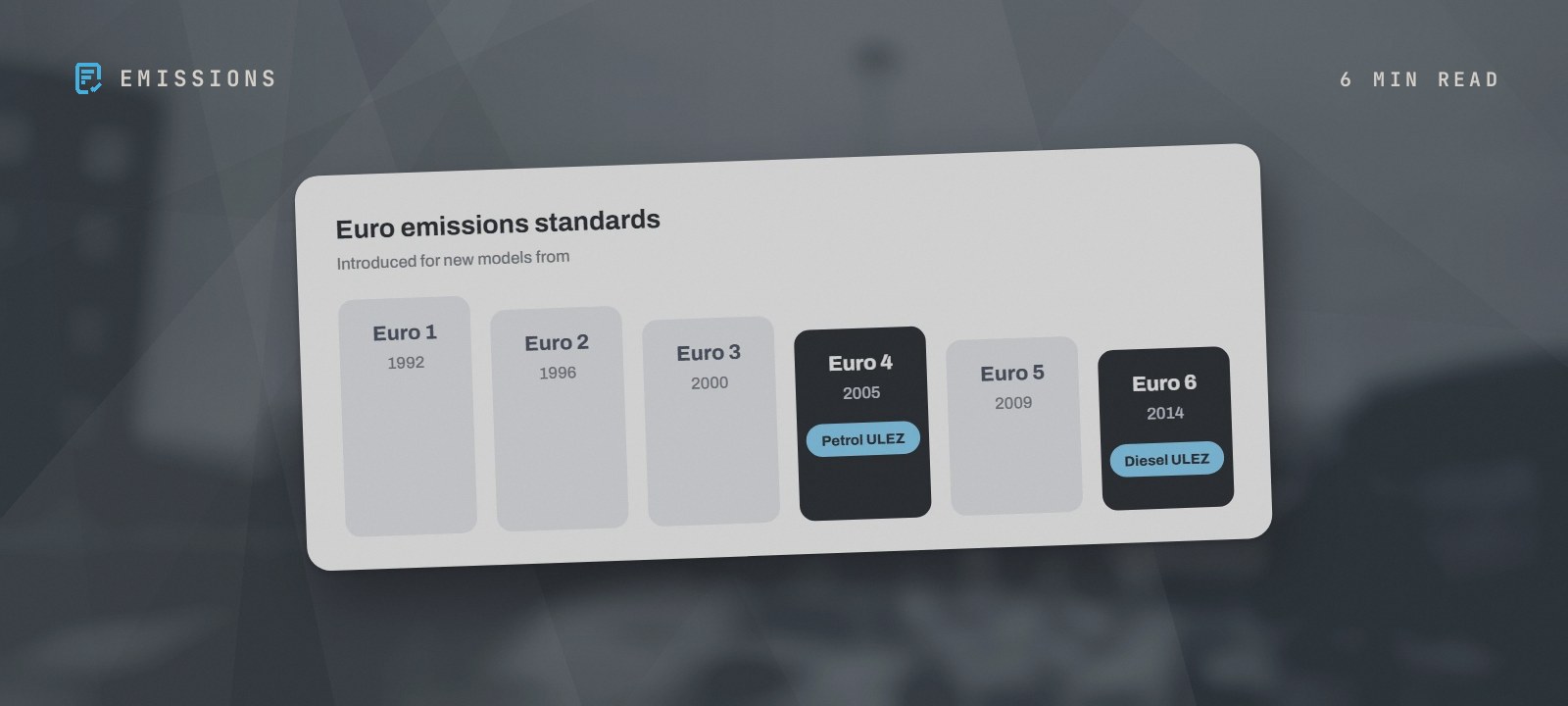
Your car's Euro emissions standard is set by when it was first registered, and only two thresholds really matter in the UK: Euro 4 for petrol (new registrations from January 2006) and Euro 6 for diesel (from September 2015).
Meet them and you drive through ULEZ and every English Clean Air Zone without paying. Fall the wrong side and it's a charge every single day.
What are the Euro emissions standards?
They're Europe-wide limits on the pollutants a new car may emit, principally nitrogen oxides (NOx), carbon monoxide and particulates. The limits have tightened in numbered steps since the early 1990s, and every car meets the standard in force when it was type-approved.
The standard says nothing about CO₂ or fuel economy; it's about the air-quality pollutants that clean-air zones police.
When did each Euro standard start?
For new registrations, the steps landed roughly like this (type approval for new models came about a year earlier in each case):
| Standard | All new cars from | Worth knowing |
|---|---|---|
| Euro 1 | January 1993 | Catalytic converters became universal |
| Euro 2 | January 1997 | Separate petrol and diesel limits |
| Euro 3 | January 2001 | NOx limited in its own right |
| Euro 4 | January 2006 | The ULEZ bar for petrol |
| Euro 5 | January 2011 | Particulate filters on diesels |
| Euro 6 | September 2015 | The ULEZ bar for diesel |
Treat the dates as strong rules of thumb rather than guarantees: a car registered near a cut-off can sit either side, because the standard follows the model's approval, not the plate.
Which Euro standard do ULEZ and Clean Air Zones require?
The same pair everywhere in England: London's ULEZ charges non-compliant cars £12.50 a day and defines compliance as Euro 4 for petrol and Euro 6 for diesel, and the English Clean Air Zones in cities such as Birmingham, Bristol and Bradford use the identical thresholds (only some of them charge private cars at all).
Scotland's Low Emission Zones use the same standards but fine non-compliant cars outright instead of selling a daily pass. Fully electric cars are compliant everywhere by definition. Check any reg against every UK zone with our ULEZ and Clean Air Zone checker.
How do you find your car's Euro standard?
Three places, in order of certainty: the V5C logbook's exhaust emissions section (newer logbooks state the standard), the zone operators' own checkers, and the registration-date rules of thumb above.
Because a borderline car can surprise you, a recorded status beats guessing. Our history report shows the Euro standard held for the car's model, alongside the CO₂ figure and tax band from its DVLA record, and the logbook or the zone's own checker confirms it for the exact car before you buy.
What is Euro 7 and when does it start?
Euro 7 is the next step, and the first to regulate brake and tyre particles as well as exhaust gases. In the EU it applies to newly approved car models from late November 2026 and to all new cars about a year later.
Britain hasn't adopted it yet: the government consulted in 2026 on aligning with Euro 7, and at the time of writing no start date has been set for GB-registered cars. None of this changes the zones: ULEZ and CAZ thresholds stay at Euro 4 petrol and Euro 6 diesel unless their operators say otherwise.
Does the Euro standard matter when buying used?
It can be the difference between a bargain and a money pit. The classic trap is the 2011-2015 Euro 5 diesel: cheap to buy precisely because it pays £8 to £12.50 a day in city zones, which can wipe out the saving in a few months of commuting.
If you live near a zone, filter your search by compliance first and price second, and weigh an older diesel against a newer compliant alternative over your real mileage. Our car tax guide covers the other emissions-linked cost worth checking at the same time.