A SORN, or Statutory Off Road Notification, tells DVLA that a car is being kept off the public road. While it's in force the car needs no vehicle tax and no insurance, any full months of tax already paid come back automatically, and making one costs nothing.
What is a SORN?
A SORN is DVLA's record that a vehicle is off the road and untaxed on purpose. The letters stand for Statutory Off Road Notification, and making one lifts the legal duty to tax and insure the car.
People SORN a car for ordinary reasons: a classic stored over winter, a project car mid-restoration, a second car nobody is driving, or a car waiting to be sold or scrapped.
How long does a SORN last?
A SORN lasts until you tax, sell, scrap or permanently export the car. It has no expiry date and never needs renewing, so a car can stay SORN for years.
Two rules go with it. GOV.UK says the car has to stay in the UK for the SORN to be valid, and a SORN never passes to a new keeper, so it ends on the day the car is sold.
How do you make a SORN?
You make a SORN free on GOV.UK or by phone on 0300 123 4321. It takes a few minutes.
- The reference. Use the 11-digit number from the V5C logbook or the 16-digit reference on a vehicle tax reminder. Without either, you post a V890 form to DVLA with a V62 application for a new logbook, which costs £25.
- The start date. A SORN starts straight away, unless you apply in the month the tax runs out, when it starts on the first of the next month. You can't backdate one.
- The refund. DVLA refunds any full months of tax left, worked out from the date it receives the SORN.
Can you drive or park a SORN car on the road?
No, with one exception. A SORN car can be driven to and from a pre-booked MOT or other test, and it must be insured for that trip.
The rest of the time it has to stay in a garage, on a driveway or on other private land. Parking it at the kerb outside your house counts as keeping it on the road. GOV.UK warns that using a SORN car on the road risks prosecution and a fine of up to £2,500.
Does a SORN cancel your car insurance?
No. Making a SORN doesn't tell your insurer anything, so the policy carries on until you change or cancel it yourself.
The law stops requiring insurance once the SORN is in place, but you can still keep cover against fire and theft while the car is stored. Ask your insurer how a break in cover affects your no-claims discount before you cancel, because each insurer sets its own rules.
How do you check if a car is SORN?
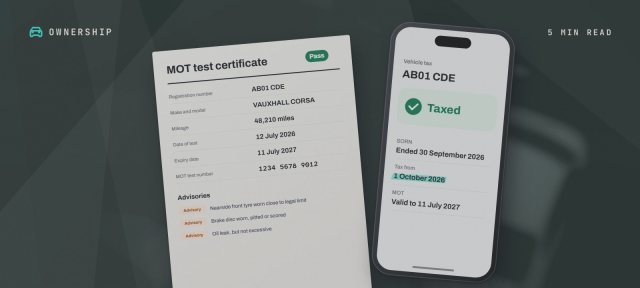
Enter the registration on GOV.UK's free Check if a vehicle is taxed service. It shows whether the car is taxed, untaxed or SORN.
A new SORN can take up to two working days to show, so a car SORNed yesterday may still look untaxed. Our free MOT check adds the test history, which shows how long a car sat between tests.
How do you take a car off SORN?
You tax it. There's no separate form to cancel a SORN, and it ends automatically the moment the car is taxed.
The car needs a valid MOT before it can be taxed, if it's old enough to need one, and DVLA confirms you can drive it to a pre-arranged test. Our guide to taking a car off SORN goes through the steps, including the wait for a new MOT to reach DVLA's records.
Should you worry about buying a car that's been SORN?
A SORN in a car's past isn't a red flag by itself. A long gap is worth asking about, though, because cars don't enjoy sitting still:
- Tyres flat-spot and perish if a car sits on them for months or years.
- The battery may be flat or ruined from deep discharge.
- Brakes can seize, and fluids degrade.
- The MOT history shows the pause. A long gap between tests, then a fresh MOT just before the sale, is one to look at closely.
None of that rules a car out at the right price. A vehicle report shows the tax band and the full MOT timeline, so a long gap stands out, and our buying checklist covers the physical checks that matter most on a car that's been standing.