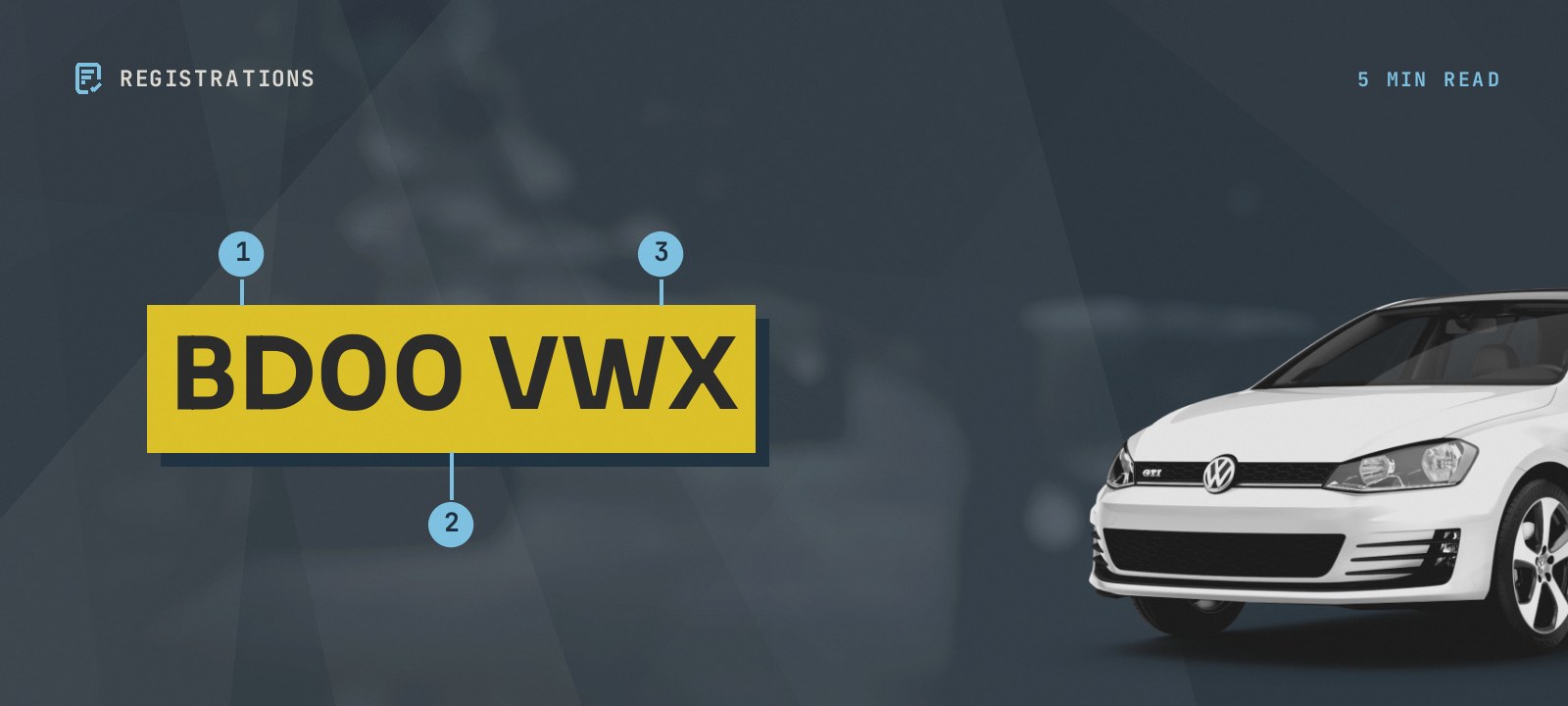
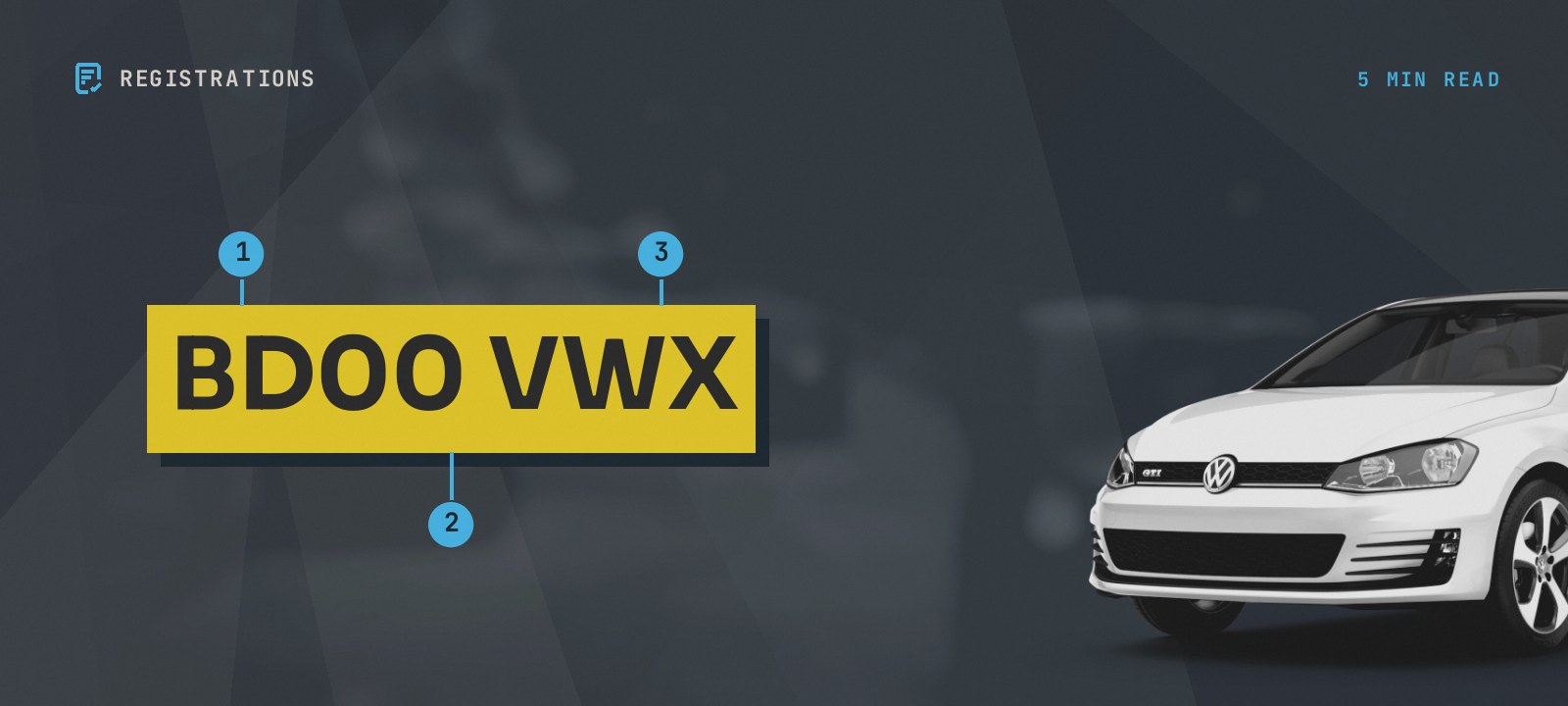
Every plate on a British road follows one of five schemes, and each was replaced only because the last one ran out of combinations. That history is why a 1974 Escort, a 1998 Fiesta and a 2024 Kia carry registrations that look nothing like each other. Learning to read them takes a couple of minutes and pays for itself the first time a seller is vague about how old a car really is.
The current format (2001 onwards)
Since September 2001, plates follow the pattern two letters, two numbers, three letters: AB12 CDE. Each part means something:

- The first two letters are the local memory tag: where the car was first registered. L-something is London, Y-something is Yorkshire, S-something is Scotland, and so on.
- The two numbers are the age identifier, and this is the bit worth memorising. Plates issued March to August use the year itself: a car registered in May 2025 gets 25. Plates issued September to February add 50: registered in October 2025 gets 75. So 25 and 75 are both 2025 cars, six months apart.
- The last three letters are random; they're just there to make the combination unique.
The system was designed with enough combinations to run until 2051, so this is the format you'll see on anything modern.
Prefix plates (1983–2001)
The format before that ran the age letter first: A123 BCD. The leading letter is the year: A for 1983, B for 1984, up to Y in 2001 (I, O, Q, U and Z were skipped). One letter per year at first, then two registrations per year from 1999. A "P-reg" is a 1996–97 car; anyone who grew up in the UK in the nineties can still do this conversion without thinking.
Suffix plates (1963–1982)
Same idea, mirrored: ABC 123D, with the year letter at the end. A suffix of A is 1963, B is 1964, through to Y in 1982. These days you'll mostly meet suffix plates on classics at shows, and out in force every summer when the show season brings them onto the road.
Dateless registrations (1903–1963)
The oldest format has no age information at all: one to three letters followed by one to four numbers (or the reverse), like ABC 123 or 123 ABC. Because they carry no year, dateless plates became the backbone of the private plate trade: a dateless registration can legally sit on a car of any age, which is also why the car under one needs checking rather than guessing.
Northern Ireland plates
NI runs its own system: letter groups containing an I or a Z (letters mainland area codes never use) with up to four digits: ABZ 1234, XIA 382. Like dateless plates, they carry no age identifier, are perfectly valid across the whole UK, and are cheap enough that they're sometimes bought purely to disguise a car's age. An NI plate on a car in Carlisle isn't sinister on its own, but it removes the at-a-glance age check, so lean on the paperwork instead.
Why any of this matters when buying
Three practical uses. First, age-check the seller's claims: if the ad says 2019 and the plate says 68, that's September 2018 to February 2019: fine. If the plate says 66, someone's rounding generously. Second, spot the plate games: a private or NI plate isn't a problem, but it's often hiding either vanity or age, and you want to know which. A history check lists previous registrations, so you can see what the car wore before. Third, catch the typo before it costs you: when you're checking a car remotely, one wrong character means you're reading some other car's history. (Our lookup validates the format of every plate style above before taking any money, for exactly that reason.)
The rules sellers can't break
You can move a registration between vehicles, but DVLA's one iron rule is that a car can never be made to look newer than it is. A 2010 car can wear a dateless plate or a 2005-style plate; it can't wear a 24 plate. So a modern-format plate is a reliable oldest possible date for the car: if it wears a 21 plate, it was registered no earlier than March 2021. That one-way rule is a small but genuinely useful check when a car's story doesn't quite add up.